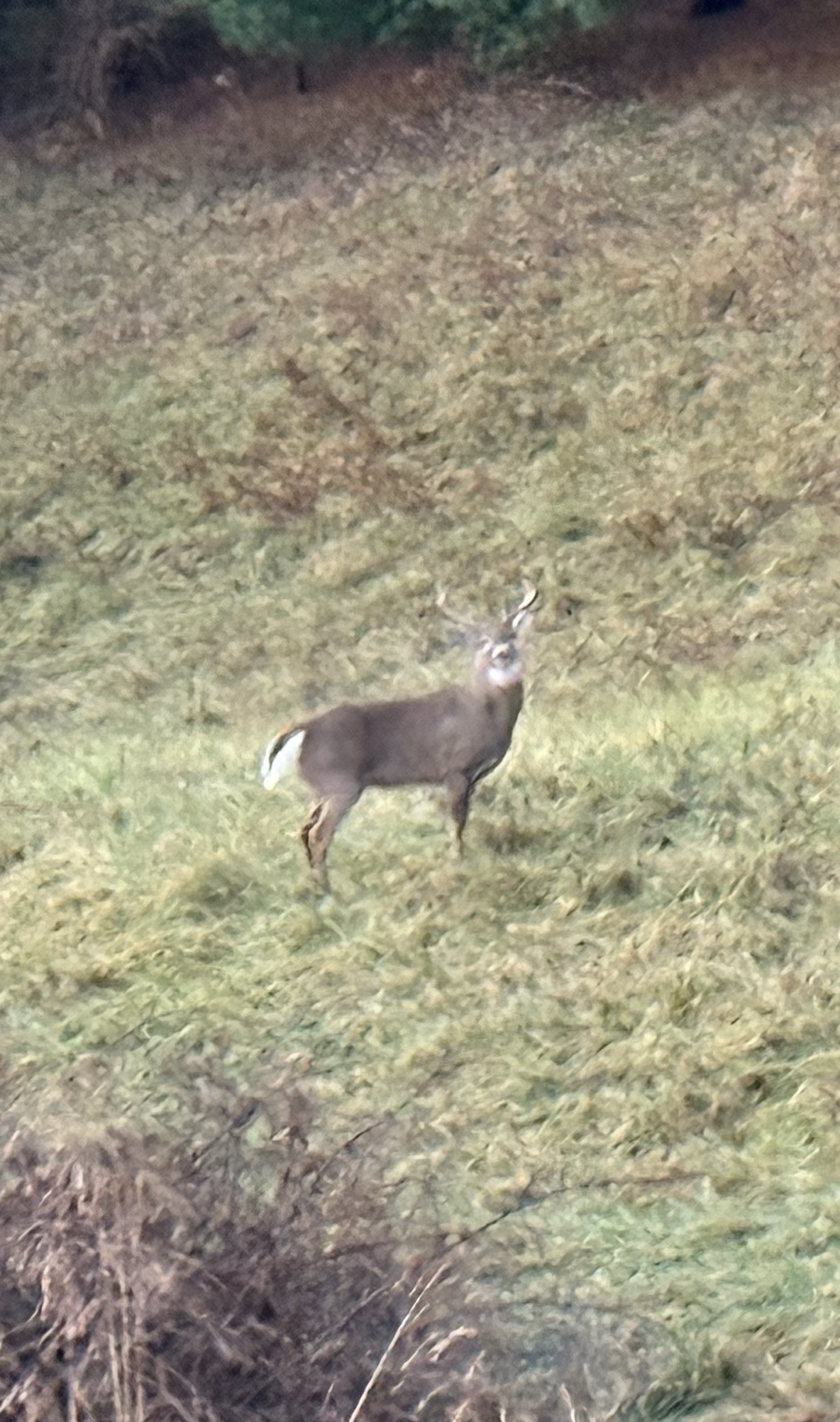
This trip kept my spirits high all week. Fresh off a business trip and on Dan’s birthday, we headed to the Appalachians for opening day of deer season.
Last year was freezing; despite seeing deer the night before, we only got one with a lucky shot right before legal time ended and had to wait until morning to retrieve it.
This year, we came prepared: a new blind, comfy chairs, a shooting stick (Dan’s birthday gift from Rose), and a hitch-mount hoist for easier processing. Setting up the blind late at night, we ended Dan’s birthday with a nightcap and woke at 5:50 am. We spooked three deer going in but settled in by 6:25, just before legal shooting at 6:38.
Soon after settling, I spotted a big 12-point buck. He stayed in view for ten minutes, but Dan couldn’t see him through his scope, and I passed on an iffy shot. We let him go.
Two minutes later, a doe appeared at 90 yards, and another at 15 yards. Dan dropped the closer one cleanly. Then a buck followed; I shot him, but he ran off. We waited, and soon a huge doe appeared where the big buck had been. Dan let me take the shot—she ran uphill after a solid hit.
Walking back for coffee, Dan spotted another doe and dropped her instantly. By 7:07 am, we had four deer down before sunrise. Dan’s two were easy to recover; my doe was near his second, but my buck still needed to be found.

Blood trail tracking is a great skill, especially in the Appalachian woods. Every other leaf on the ground is red. First, let’s find the point of impact. Again, the sun was not even up properly, so I used the app Francisco suggested: TracknTrail.

I found the impact point in two seconds, found a nice piece of lung tissue, and a lot of blood.
Very promising. Lots of blood… a clear blood trail. Being cheap, I didn’t subscribe to the app, just used the trial—so I won’t blame them for misleading me.

That app—using the app solely and not my common sense—led me on a tiring uphill walk through wet, long grass for 20 minutes. I didn’t find the buck, and last year’s frustration slowly crept back; I can’t lose a deer with such a lung shot!
Reaching the ridge, I saw the initial target, the 12-pointer.

He let me get within 100 feet, then ran away, and to my surprise, a doe darted out from the bushes a second later. I thought that was my buck, so I checked the bedding area to see if I could find blood, but nothing. I walked back to see how far Dan was with his two.
He had tagged and moved the first doe shot from the blind to the house, and we walked down to see the two lying next to each other. Quick tagging after identification. This required some pickup truck power—two does and me on the tailgate—we got back to the house. Now, let’s find the buck.
Dan walked 30 feet from the house and started to laugh. I knew he had found it—and yes, my buck was lying down in the nearby bushes. A nice 8-pointer, heavy as a rock.

Both of us—using a deer drag—wrestled him up the slope; we could barely catch our breath when we arrived. It was 7:31 am when the buck was tagged, so by 7:50, we were ready for coffee and some pictures.

Let’s speak a bit about the details. We were both sitting in a blind Dan bought in August and tried out during bow season (without results). It’s comfortable for two with a gun for each hunter, or two hunters with one bow. Both of us use a Tikka .308 with self-made bullets. Both rifles are suppressed.
Even though we usually shoot at 600-800 yards on long range, all of our deer were taken within 70 yards. Our scopes are both zeroed at 100 yards. Dan’s load is a 165-grain Hornady ELD-X over 44 grains of Varget. My load is a Hornady 165-grain BTSP Interlock over 44 grains of Varget—mine are 2.91” seated bullets on Winchester large rifle primers. Still, what a difference in results…
Checking the wounds, my doe had an exit wound on the side, just staying within the diaphragm, avoiding the gut shot. We processed that one first out of fear of contamination, but thankfully, it was a clear lung shot. Both of Dan’s shots were in the heart; the bullets opened nicely, no exit wound. My buck had a closed-down incoming point (this particular projectile usually results in this), which was hard to find, and a larger but not too massive exit wound where the lung tissue exited. The impact of both rifles was visible on the meat in some areas: 2750 fps from a 22-inch barrel with a 165-grain projectile has significant stopping power.
We debated whether we even need .308s if most of our hunting distance is under 100 yards, but agreed that .308 is the most practical for North Carolina targets. Maybe a bit overkill, but definitely handy, resulting in a relatively short blood trail while minimal meat waste if shot on the great spot. Oh, for the record, Dan shoots .75 MOA groupings while I maintain my 1 MOA with our hunting Tikkas.
I mentioned that both rifles were suppressed: the deer visibly made no big deal out of the shots fired, not even when their companions were down. After getting coffee and stepping out of the house, we saw two more within 100 yards. What a morning.
Processing started ASAP. We had four to process but just one hoist. It started to rain and we had a lot to do… We started with my doe: skin it, backstrap, hams, shanks, take all the meat off, then remove the head to determine age and pull the CWD sample—it took us two hours.


The meat went into labelled bags, the extracted retropharyngeal lymph nodes were sealed, labelled, and frozen. This doe was 3.5 years old, gave a ton of meat, gorgeous neck meat and shanks, not to mention huge backstraps and hams.
Next, Dan’s first doe was 2.5 years old, the second doe was 1.5 years old. Between each deer, we cleaned and sanitized everything. This was our division of labor: I hooked the deer up, cut what needed to be cut, Dan helped pull the hide, then held it to help me take the different pieces away. Dan handled administration, labeling bags, storing them in the right cooler, cleaning and sanitizing the workplace, knives, and the hoist, and properly discarding the carcass and remains.
It took us until 1:30 pm to process everything properly. No, we do not leave anything on the bones. These deer gave their lives to feed two families; it is the minimum to handle them with respect and without waste.
By the time we got home to the Raleigh area by 6 pm, we were both exhausted—tired, barely able to move, but happy, so happy! This was a perfect season opener in the mountains.

(Picture from mid-August, 2025)